
Framework
The adoption curve: how innovations spread (and how to cross it)
From Rogers' five adopter segments to Moore's chasm — a clear guide to the adoption curve and the practical moves that accelerate adoption across the market and inside accounts.
What is the adoption curve?
The adoption curve, originally described by Everett Rogers in Diffusion of Innovations, is a bell curve that segments a market by how quickly people adopt a new product or technology.
Origin and definition
Rogers showed that adoption follows a roughly normal distribution over time, with distinct psychological profiles at each stage of the curve.
Why it still matters
Modern SaaS, hardware, and platform launches still follow this shape. Strategy, messaging, and pricing should change as you move across the curve.
The five adopter segments
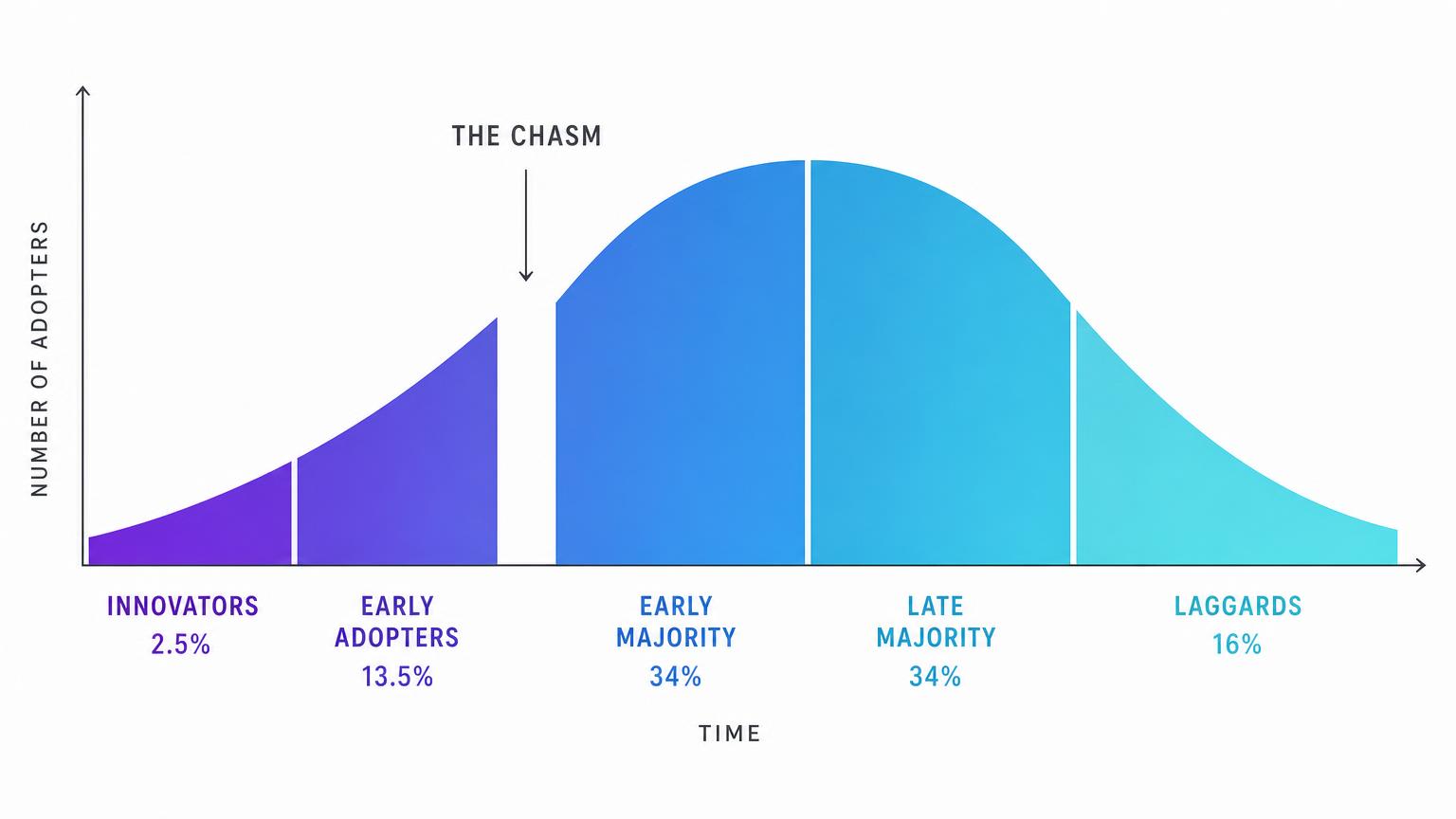
Innovators (~2.5%)
Risk-tolerant enthusiasts who try new things for their own sake. Useful for feedback, not for revenue.
Early adopters (~13.5%)
Visionary buyers who use new products to gain advantage. They tolerate rough edges in exchange for upside.
Early majority (~34%)
Pragmatists who adopt once a product is proven. They want references, case studies, and integrations.
Late majority (~34%)
Conservatives who adopt once a product is the safe default. They want standards, support, and predictable pricing.
Laggards (~16%)
Skeptics who adopt only when there is no alternative. Often regulated or budget-constrained buyers.
Crossing the chasm
Geoffrey Moore extended Rogers' work by identifying a gap between early adopters and the early majority — the chasm — where many promising products stall.
Why the chasm exists
Early adopters buy vision; the early majority buys references. A product that wins on novelty loses when the next segment asks 'who else like me uses this?'
How to cross it
Pick a beachhead segment, build a whole product (integrations, services, references) for that segment, and dominate it before expanding.
How to accelerate adoption
Match messaging to segment
Vision and disruption for early adopters. Proof, ROI, and references for the majority.
Invest in references and case studies
The early majority does not buy claims — it buys peers. Treat customer evidence as a product.
Reduce switching cost
Migrations, integrations, and onboarding programs are the levers that move conservative buyers.
Measure adoption inside accounts
Adoption is not just a market shape — it is also a within-account curve from champion to broad usage.
Frequently asked questions
+Who created the adoption curve?
Everett Rogers, in his 1962 book Diffusion of Innovations. Geoffrey Moore later extended it with the concept of crossing the chasm for technology markets.
+What are the five stages of the adoption curve?
Innovators, early adopters, early majority, late majority, and laggards — roughly 2.5%, 13.5%, 34%, 34%, and 16% of a market.
+What is the chasm?
The gap between early adopters and the early majority. Early adopters buy vision; the majority buys proof. Many products stall here because they cannot earn the references the next segment needs.
+How long does it take to cross the chasm?
There is no fixed timeline. Categories with strong network effects can cross in a year; enterprise categories often take three to five. Focus and references compress the time more than effort does.
+How does product adoption inside a company relate to the adoption curve?
The same curve repeats inside large accounts — innovators and early adopters become internal champions, and the majority follows once the champions show results.