
Playbook
Customer Onboarding: a playbook for B2B and SaaS teams
A practical playbook for designing a customer onboarding program that converts signed contracts into retained, expanding accounts — with the phases, roles, and metrics that matter.
What is customer onboarding?
Customer onboarding is the cross-functional program that takes a paying account from contract signature to confident, productive use. It spans product, customer success, support, and often professional services.
Customer onboarding vs. user onboarding
User onboarding is in-product and per-user. Customer onboarding is account-level and includes humans, training, integrations, and change management.
Why it directly drives retention and expansion
Onboarded customers renew at materially higher rates and expand earlier. Time-to-value is the single best predictor of net retention.
The four phases of customer onboarding
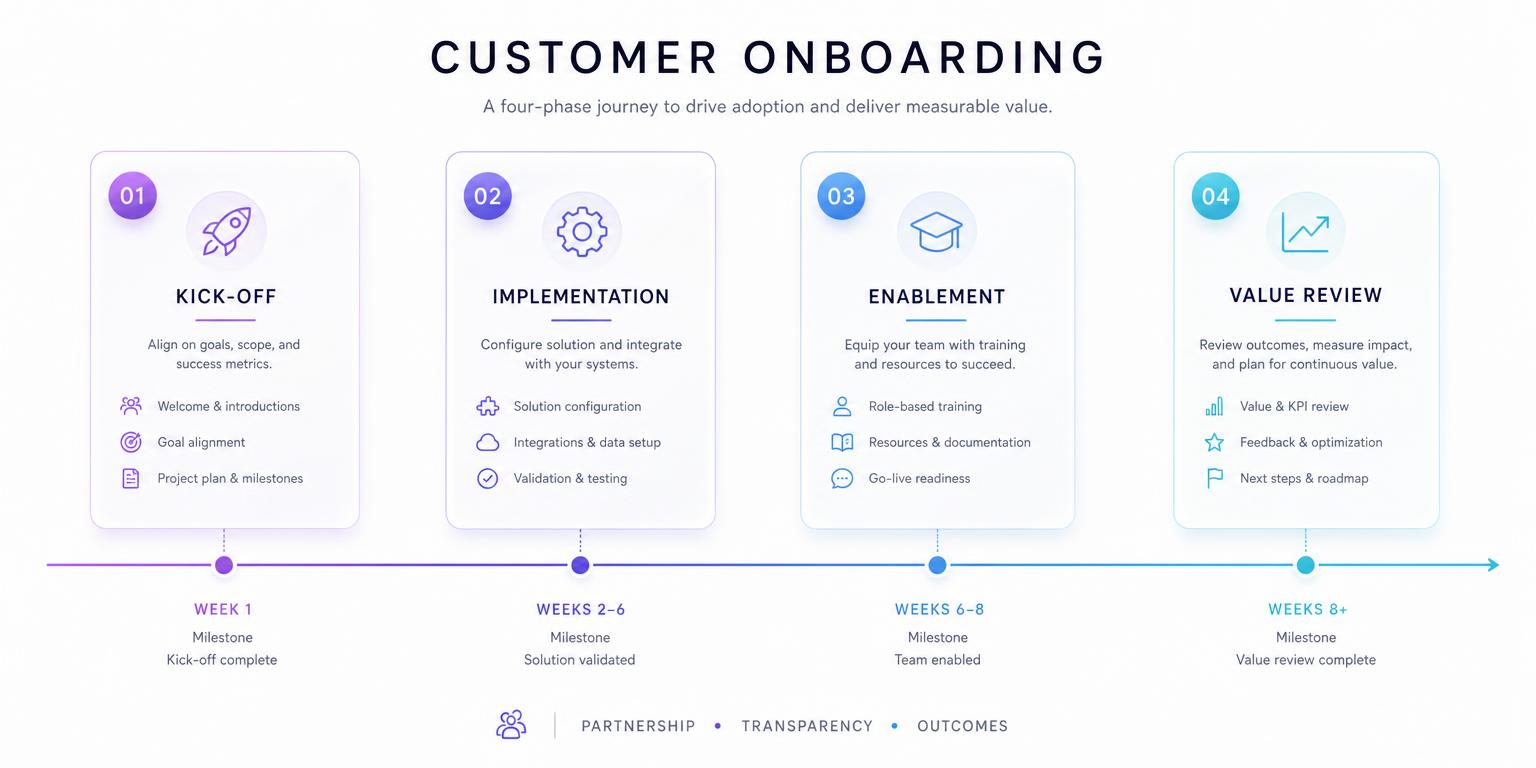
Phase 1 — Kickoff
Align on goals, success criteria, stakeholders, and timeline. The output is a written success plan signed by both sides.
Phase 2 — Implementation
Configure the product, connect integrations, migrate data, and stand up admin controls. Block the path to value, not the launch date.
Phase 3 — Enablement
Train end users in their real workflows. Document champions, role-based playbooks, and internal FAQs.
Phase 4 — Adoption handoff
Hand the account from onboarding to ongoing CS with a documented baseline of usage, sentiment, and open risks.
Roles and responsibilities
Onboarding manager
Owns the plan, the schedule, and the success criteria from kickoff to handoff.
Solutions / implementation engineer
Owns technical setup, data, and integrations.
Customer champion
The buyer-side owner who drives internal change and rallies end users.
Executive sponsor
On both sides — unblocks scope, budget, and political issues.
Metrics that matter
Time to first value (TTFV)
Days from contract to first measurable outcome inside the account.
Time to full deployment
Days from contract to the target seat count actively using the product.
Onboarding NPS or CSAT
Surveyed at the end of each phase — early signal for renewal risk.
Net retention at month 12
The ultimate scoreboard. Strong onboarding shows up here twelve months later.
Frequently asked questions
+How long should customer onboarding take?
It depends on deal size and complexity. SMB tools target days to weeks; mid-market 30–60 days; enterprise 60–120 days. Shorter is almost always better.
+Who owns customer onboarding?
Usually a dedicated onboarding manager or implementation lead reporting into Customer Success or Professional Services, with cross-functional support from product and support.
+What should the onboarding success plan include?
Business outcomes, measurable success criteria, stakeholders on both sides, integration scope, training plan, and a written go-live date.
+How is customer onboarding related to product adoption?
Onboarding establishes the conditions for adoption — configuration, training, and habits. Adoption is what happens when those conditions are met across the customer's organization.
+How do we know onboarding is working?
Track time-to-first-value, time-to-full-deployment, onboarding CSAT, and 12-month net retention. If those trend in the right direction, onboarding is working.