
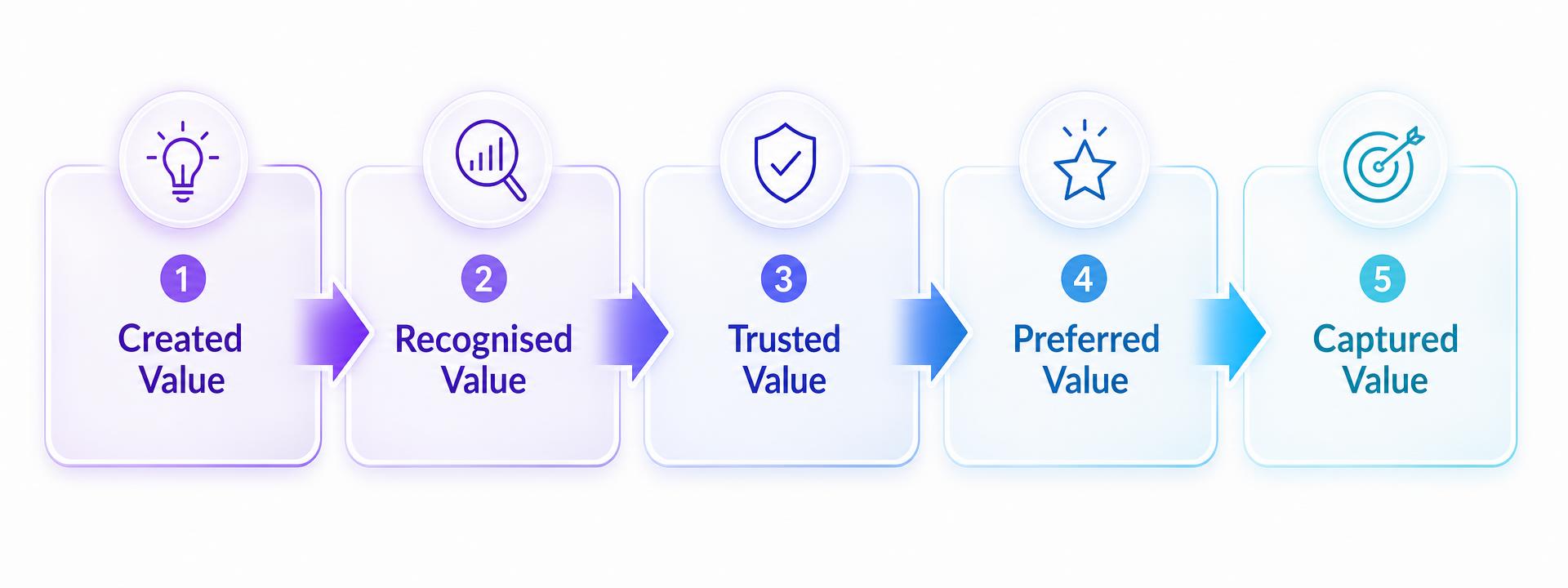
If your product is genuinely new, the problem usually isn't that people haven't heard of it. It's that the market doesn't yet have the words, the reference points, or the proof to understand why it matters. That is how a technically brilliant product ends up commercially invisible — and it is where education-based lead generation earns its keep. Done well, it does not just generate leads: it helps buyers make sense of something new, and moves value from Created to Recognised, Trusted, Preferred and finally Captured.
01What this actually means
Education-based lead generation starts with what the buyer needs to learn, not what you want to say about your product. In practice, that means building something — a report, an assessment, a webinar, a workshop, a guide, a diagnostic tool, or a pilot — that helps one specific audience make sense of a decision they have not made before.
Your product should show up somewhere in this process, but it cannot be the whole point of it. If every lesson ends with a pitch, buyers notice — and the format stops working the moment it is recognised as a sales tactic wearing a teacher's coat.
This is not only theory. A 2024 study of ICT companies found educational content mattered most for complex, high-value B2B sales — precisely the situation most innovative products are in. [1]
- See a problem they had not clearly named before.
- Understand why their current approach will not be enough.
- Weigh up a new way of solving it.
- Work out whether it is genuinely relevant to their situation.
- Feel less nervous about the risk of changing.
- Build a case they can take to their own manager.
02Why new products are harder to sell than familiar ones
With an established product category, buyers already have the context: they know the problem, recognise the terminology, and can compare it against alternatives they have seen before. An innovative product gets no such head start. Before a buyer can say yes, they usually work through seven separate recognition gaps.
This is not one straight line — it is several people moving at different speeds. Your technical contact might understand it in the first meeting while the person who controls budget is still unconvinced six weeks later. A senior sponsor may love the strategic potential while the team that has to use it daily worries about disruption.
Lead generation alone will not close these gaps. Only education moves the whole buying group toward a shared understanding.
Seven recognition gaps — select one
01 · Problem recognition
“Is this worth solving now?”
The buyer has not yet named the problem clearly, or does not see it as urgent compared with everything else on their list.
What usually closes it
Diagnostic assessment, benchmark, problem-framing article
03Think flywheel, not funnel
A funnel is useful for tracking movement toward a single transaction, but it undersells how innovative products actually gain traction. Education does not stop once a lead becomes an opportunity, and value recognition does not end at the first sale.
A flywheel is the better model, because each stage feeds the next: educate, engage, validate, evidence, enable, adopt, learn, improve. The payoff compounds — questions from one workshop sharpen the next piece of content, pilots become evidence, adoption becomes a case study, and satisfied customers become your most credible (and unpaid) educators.
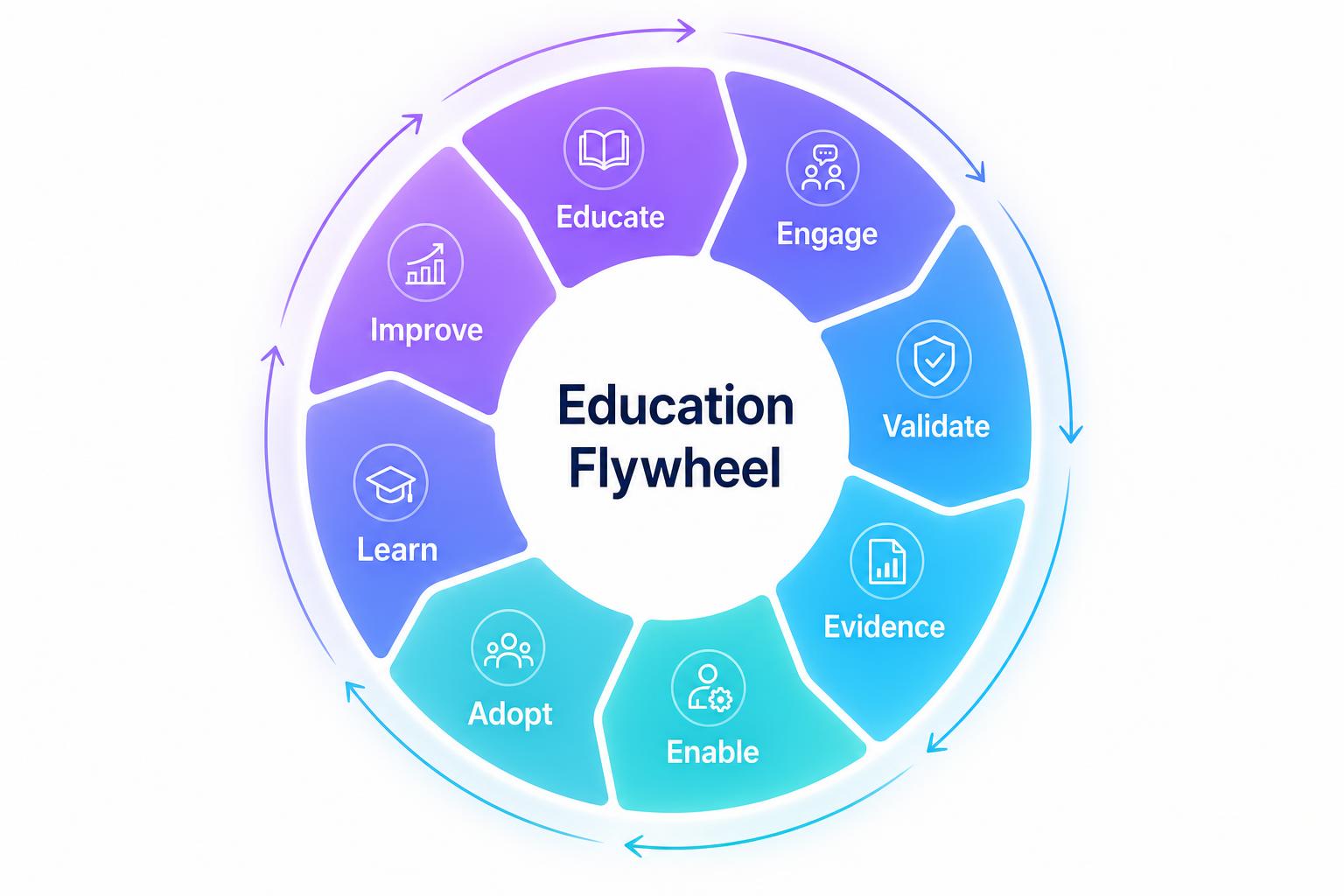
- Educate — help people understand a real problem or opportunity.
- Engage — talk through how it applies to their specific situation.
- Validate — test whether it is relevant and whether they are willing to act.
- Evidence — back it up with a demo, pilot result or customer outcome.
- Enable — give your champion the language and materials to sell it internally.
- Adopt — help them implement it and become genuinely good at using it.
- Learn — collect the questions, objections and results this produced.
- Improve — feed all of that back into the product, the pitch and the next round of education.
04How value moves through the buying process
Created to Recognised: you know what you have built, but the market does not yet know why it matters. Describe the problem in the buyer's language, what the old way is costing them, what is changing in their market, and what is now possible. Best formats: diagnostic assessments, problem-framing articles, research reports, executive briefings. The goal is not visibility — it is the right people understanding the problem accurately.
Recognised to Trusted: understanding a claim is not the same as believing it. For something unfamiliar, trust comes from evidence — how it works, where it has worked before, which assumptions the results depend on, and where the limits are. Best formats: detailed case studies, technical explainers, security and compliance briefings, live demos, well-designed pilots. What builds trust fastest is being honest about trade-offs rather than polishing them away.
Trusted to Preferred: being credible does not make you the chosen option. Buyers are also weighing competitors, building it themselves, waiting, or doing nothing. Education should help them work through strategic fit, feasibility, cost and risk — and arm your internal champion to make the case to colleagues who were not in the room. Best formats: decision frameworks, comparison guides, tailored business cases, stakeholder workshops, implementation roadmaps.
Preferred to Captured: a signed contract is not captured value. Value is captured once the product is adopted, used properly, and actually produces the promised outcome. So education continues through onboarding, role-specific training, user communities and progress reviews. A demonstrated outcome is far more convincing to your next prospect than any promotional claim.
05One audience, several different people to convince
Trying to educate an entire market at once is a common way this goes wrong. Start narrower: one priority Ideal Client Profile, and one problem that is clearly worth solving. That does not mean one message for everyone inside the account — each stakeholder is answering a different question.
One consistent story, answering six different questions: that is the balance to aim for.
| Stakeholder | What they need to figure out | What convinces them |
|---|---|---|
| User or practitioner | Will this actually work day-to-day? | Demo, workshop, peer use case |
| Technical evaluator | Can we integrate it and stay in control? | Architecture guide, security evidence, technical session |
| Operational leader | What will implementation really require? | Workflow map, pilot plan, adoption framework |
| Financial buyer | Is the return big enough, and what is the risk? | Return logic, cost-of-inaction analysis, scenario model |
| Executive sponsor | Does this matter strategically, right now? | Executive brief, benchmark, strategic business case |
| Procurement / compliance | What is the commercial and regulatory exposure? | Compliance pack, contract terms, evidence record |
06Match the format to the gap, not to what is easiest to publish
Problem awareness grows through original research and benchmarks, problem-framing articles, maturity assessments and expert roundtables. Understanding of the solution grows through role-specific webinars and workshops, a library of real use cases, process maps and demos organised around outcomes rather than feature lists.
Trust grows through evidence-rich case studies, technical and compliance briefings, plain explanations of your methodology, and pilots with success criteria agreed up front. Internal decision-making is helped by business-case tools, stakeholder-specific summaries, comparison frameworks and implementation roadmaps. Adoption sticks through onboarding programmes, training for users and leadership, playbooks, impact reviews and user communities.
One asset can serve more than one purpose, but it should still have one clear job and one clear audience. If you cannot say who it is for and which question it answers, it is not ready yet.
07Use events to learn, not just to broadcast
Webinars, workshops, roundtables and small executive events are especially valuable for new products because they run in both directions. You are teaching, but you are also finding out which problems create real urgency rather than polite interest, which words the market actually uses, which claims land, who shows up, and what proof people need before taking the next step.
Registration and attendance numbers are easy to track and tell you very little. The real question is whether people left with a clearer understanding and a next step that makes sense for where they are.
- A defined audience and a clear learning goal.
- A problem that is genuinely worth their time.
- Real evidence or a useful framework, not a pitch.
- Actual interaction, rather than a monologue.
- A way to capture the questions and objections raised.
- A next step matched to how ready the person really is.
08Run two pipelines, not one long list of leads
It helps to separate two very different groups. The active opportunity pipeline holds real need, the right authority and a credible timeline to decide. The education and development pipeline holds accounts that are relevant but not ready — missing recognition, internal buy-in, evidence, timing or budget.
The second group is not a dumping ground for maybe-later. Each account there should carry a clear hypothesis: what they already understand, what remains unresolved, who else needs to be involved, and what would genuinely move them forward. This keeps you from selling too early while still investing in the relationships worth the wait.
09What to actually measure
Downloads and impressions are easy numbers, but they do not tell you whether education is working. The signals below do. Work through them and see how many you can evidence today.
A 2026 study of 25 B2B technology companies found links between educational content and higher lead quality, lower acquisition cost and shorter sales cycles — and that different formats worked better at different stages: research content early on, case studies and demos closer to the decision. The sample was modest, so treat these as benchmarks to test against your own results rather than guarantees. [2]
Signals worth measuring
Tick the ones you can evidence today.
0/14
Recognition
The right people understand the problem accurately.
Trust
Understanding turns into belief.
Preference and momentum
Belief turns into a decision worth defending.
Captured value
The promised outcome shows up in practice.
10Mistakes worth avoiding
Most of these are recoverable, and all of them are easier to avoid than to repair.
- Education that is really just a pitch — if every piece leads straight to buy now, trust drops.
- Trying to educate everyone — broad content gets attention but builds little real relevance.
- A pile of content with no process behind it — someone must own sequencing, distribution and follow-up.
- Treating every participant as sales-ready — curiosity, understanding and readiness to buy are three different things.
- No next step after the learning — an insight that leads nowhere produces an informed person who does nothing.
- Stopping at the signature — skip post-sale education and the value you promised may never appear.
11Building this as a real capability
This is not a content calendar. It is six things working together: market understanding (a clear ICP, a priority problem and the buying context), value articulation (a plain link between what you do and why it matters), educational design (content built to help people understand, not merely to be published), evidence development (proof proportionate to the size of the decision), commercial orchestration (marketing, sales, product, implementation and customer success working from the same playbook), and learning and iteration.
None of this makes B2B buying perfectly predictable — it is still shaped by urgency, budget, internal politics and competing priorities. But education makes the process easier to navigate: it does some of the thinking for the buyer, arms your internal champion, and builds the evidence that makes saying yes easier.
12Where to start
If you are building this from scratch, resist doing all of it at once.
- Pick one Ideal Client Profile and one problem.
- Map the seven recognition gaps for that specific buyer — which ones are blocking them today?
- Build one asset for the biggest gap: one thing, one audience, one clear job.
- Run it, and pay attention to the questions people ask — that is your evidence for what to build next.
- Give your internal champion something to work with: a summary, a business case, anything that helps them sell it without you.
13The real question
The question worth asking is not “what content should we produce to collect more leads?”. It is: “what does this specific buyer need to understand, believe, and be able to explain to their own boss before this becomes an easy yes?”
Answer that consistently, and education stops being a content-marketing task and becomes a compounding commercial advantage.
ValueLinkPro looks at where valuable products, capabilities and expertise lose commercial momentum between creation and customer decision. The Value Recognition approach helps organisations spot gaps in recognition, trust, preference and value capture — and build the evidence, education and commercial process needed to close them.