
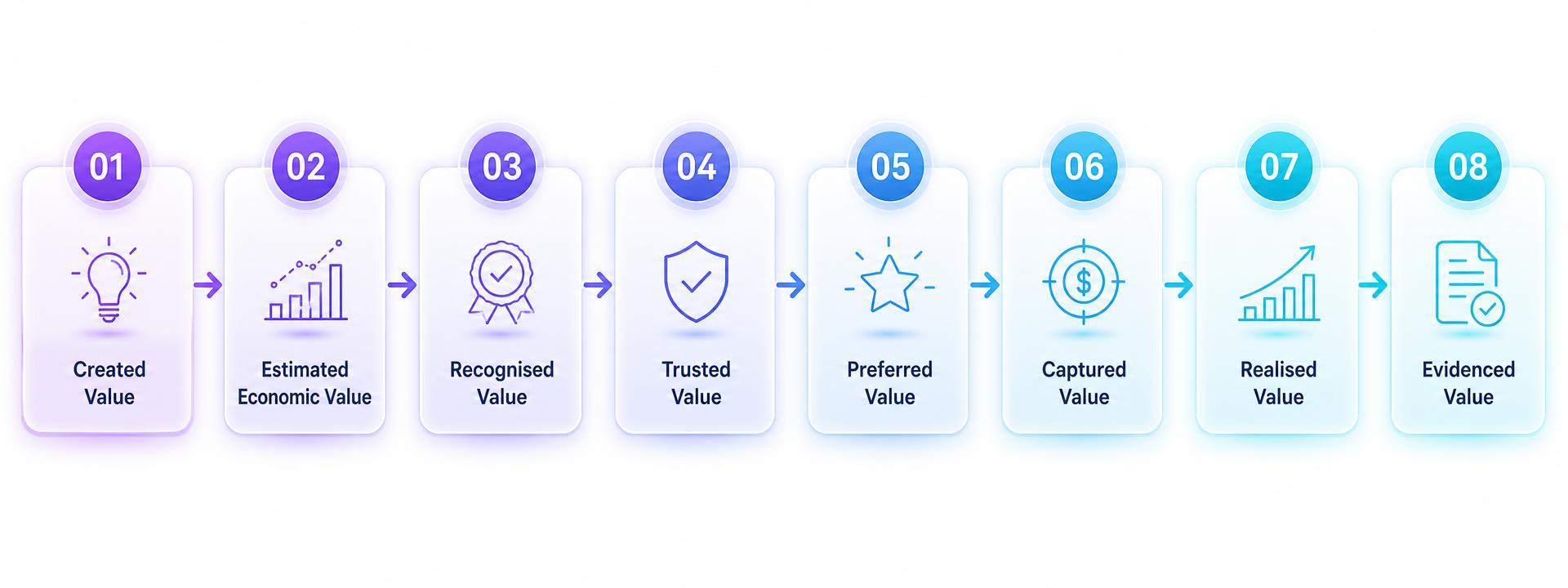
A product can create substantial value without that value becoming commercially effective. Value may be lost when the wrong customer is targeted, capabilities are not connected to customer priorities, evidence is unconvincing, or results achieved after purchase are never measured and communicated. ValueLinkPro therefore considers value as a connected eight-stage journey: Created Value → Estimated Economic Value → Recognised Value → Trusted Value → Preferred Value → Captured Value → Realised Value → Evidenced Value. Each stage answers a different customer question, and each can strengthen or weaken the commercial outcome.
01Why a valuable product may still struggle to grow
Businesses often assume that if a product solves an important problem, customers will naturally understand its importance and buy it. In practice, creating value is only the beginning.
These are not necessarily product failures. They are breaks in the Value Journey. The journey connects product development, positioning, sales, customer decision-making, onboarding, adoption and proof of outcomes. It shows how an internal capability becomes an externally evidenced result.
- The wrong customer is targeted.
- Product capabilities are not connected to customer priorities.
- Value claims are difficult to understand or believe.
- Evidence is missing or irrelevant to the target market.
- Sales promises are disconnected from onboarding and delivery.
- Realised outcomes are not measured or communicated.
- Customers cannot explain the business case internally.
02The eight stages of the Value Journey
The eight stages below form one connected route from internal capability to externally evidenced result. Select any stage in the map to see what it produces and what it depends on.
Hover a stage to explore the journey
Created Value becomes Evidenced Value through eight connected stages.
Each stage can strengthen or weaken commercial outcomes — ValueLinkPro identifies and addresses the gaps.
0301. Created Value — what the product or capability produces
Created Value is the useful improvement made possible by a product, service, innovation or specialist capability. It may reduce cost or risk, save time, improve quality, increase productivity or create an entirely new capability.
At this stage, value exists as potential. The product may be technically excellent, but customers have not necessarily understood, believed, selected or experienced it.
Typical gap: the business concentrates on features and technology without clearly connecting them to a meaningful customer problem. What moves value forward: a defined customer, an important problem, a clear outcome and proof that the capability works.
0402. Estimated Economic Value — the potential impact quantified
Estimated Economic Value translates capability into a possible business effect. It asks what difference the solution could make compared with the customer's current position or best alternative. The estimate may include costs avoided, revenue protected, time saved, productivity gained, risk reduced or faster time to market.
An estimate is not yet recognised value. It is an analytical conclusion based on assumptions. Buying remains a human and organisational decision.
Typical gap: the estimate is generic, exaggerated or based on assumptions that do not reflect the customer's reality. What moves value forward: a credible baseline, customer-specific assumptions, transparent calculations and realistic comparisons.
0503. Recognised Value — customers see why it matters
Recognised Value emerges when customers connect the product with a problem, priority, risk or desired outcome that matters to them. Recognition is more than awareness. A customer may understand what a product does without seeing why it is important. Recognition sounds like: “This addresses a problem we need to solve.”
Recognition is contextual. A finance director, operational leader, technical buyer and end user may each need to recognise a different but connected benefit.
Typical gap: the business describes capabilities from its own perspective instead of connecting them to the buyer's situation. What moves value forward: a focused Ideal Client Profile, customer language, relevant use cases and clear links between capabilities and outcomes.
0604. Trusted Value — customers believe the evidence
Recognition creates interest, but interest does not remove doubt. Trusted Value emerges when customers believe that the provider can deliver the promised result in circumstances sufficiently similar to their own. Trust may be supported by relevant case studies, measurable results, demonstrations, pilots, customer references, transparent methods and consistent messages across marketing, sales, product and delivery.
Evidence is not equally persuasive in every context. A result from another country, industry or type of organisation may demonstrate capability without proving relevance to the buyer.
Typical gap: claims are stronger than the proof, or the evidence is not relevant to the target customer and market. What moves value forward: verifiable evidence, congruent behaviour, relevant proof and clarity about how results will be achieved.
0705. Preferred Value — chosen over alternatives
A customer may recognise and trust several solutions. Preferred Value emerges when one option becomes more suitable than the others. Alternatives include direct competitors, internal processes, building a solution, postponing the decision or doing nothing.
The preferred solution is not always the one with the most features or the greatest theoretical return. It is often the one that best fits the customer's priorities, operating environment, decision criteria, risk tolerance and readiness for change.
Typical gap: the product appears credible but insufficiently differentiated, or doing nothing still feels easier and safer. What moves value forward: customer-specific relevance, meaningful differentiation, reduced risk and a clear reason to act now.
0806. Captured Value — converted into a transaction
Captured Value is the portion of recognised, trusted and preferred value converted into a commercial exchange. It may appear as a paid pilot, purchase, subscription, contract, renewal or account expansion.
Not all Created Value is captured. A company may create considerable customer value but fail to translate a fair share into revenue because the offer is poorly structured, priced or explained. The business case must also be transferable: an internal champion needs to explain the problem, expected value, evidence, risks and recommended decision to other stakeholders.
Typical gap: the proposition makes sense to one contact but cannot pass through finance, procurement, leadership or the wider buying committee. What moves value forward: commercial clarity, appropriate pricing, an internally explainable business case and a low-risk path to commitment.
0907. Realised Value — outcomes delivered in practice
Realised Value appears after the transaction, when customers adopt the solution and experience meaningful results in their own environment.
A signed contract captures value for the provider. It does not guarantee value for the customer. Realisation depends on onboarding, implementation quality, user adoption, process change, leadership support, resources and continued alignment with customer priorities. The outcomes discussed during positioning and sales should shape success measures, implementation priorities and customer reviews.
Typical gap: delivery focuses on product access, technical completion or usage while the original business outcomes disappear from view. What moves value forward: agreed success measures, clear ownership, adoption support and regular reviews against the promised outcomes.
1008. Evidenced Value — results measured and communicated
Evidenced Value is Realised Value made visible. It is created when achieved outcomes are measured, interpreted and communicated in a form that customers and future buyers can understand. Evidence may include before-and-after performance, financial results, operational data, customer testimony or a case study explaining the context, intervention and outcome.
Value can be realised without becoming evidenced. Without a baseline or measurement method, the provider loses valuable proof and the customer may struggle to demonstrate success, defend the investment or justify renewal. Evidenced Value completes the journey while also beginning the next one.
Typical gap: outcomes are assumed rather than measured, or results remain known only to a small operational group. What moves value forward: defined measures, credible attribution, customer validation and communication tailored to internal and external audiences.
11Recognition, trust and preference
Three stages play a particularly important role in turning potential value into a customer decision. Recognition begins with authenticity: the customer must understand why the solution matters, so the proposition must be grounded in what the product and organisation can genuinely deliver.
Trust grows through congruence: the customer must believe the promise and its supporting evidence, so message, proof, product experience and behaviour must support the same value promise. Preference is shaped by relevance: the solution must fit the customer's context, priorities and decision criteria better than the alternatives.
Together, these stages move the customer from understanding to confidence — and from confidence to choice.
12The journey is connected, but not perfectly linear
The eight stages form a logical sequence, but real customer journeys rarely progress in a straight line. A pilot may strengthen Estimated, Recognised and Trusted Value simultaneously. New evidence may reveal a more relevant customer segment. Implementation difficulties may weaken trust after purchase. Different stakeholders may also occupy different stages at the same time.
Value must therefore be managed across the customer lifecycle — not communicated once during a sales presentation.
- A technical buyer recognises the product's capability.
- A financial buyer still questions the economic estimate.
- An executive sponsor trusts the provider.
- End users do not yet prefer the proposed way of working.
- An operational team experiences results that leadership has not seen.
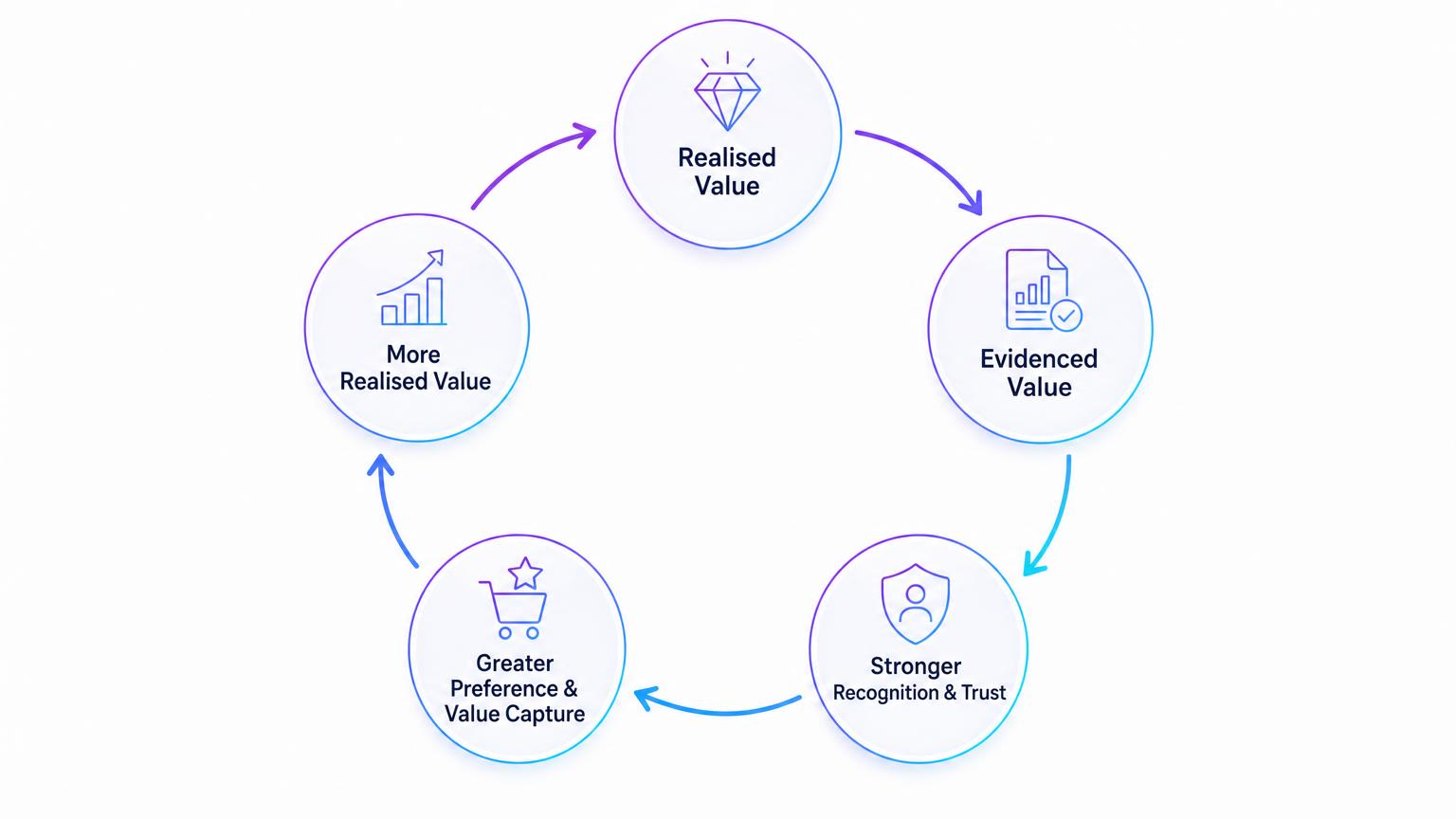
13Evidenced Value creates a reinforcing loop
The final stage does not end the Value Journey. It creates evidence that strengthens the next one: Realised Value → Evidenced Value → stronger recognition and trust → greater preference and value capture → more Realised Value.
Measured outcomes support more accurate economic estimates, stronger propositions, relevant case studies, improved onboarding, confident renewals and better product decisions.
The most useful evidence explains not only that a result occurred, but for whom, under what conditions and through which mechanism. This allows similar customers to recognise why the result may be relevant to them.
14How to identify where value is being lost
When growth is slower than expected, work through the eight questions below. The answers reveal whether the business needs a better product, sharper customer focus, a stronger economic case, clearer recognition, more relevant evidence, better differentiation, commercial redesign, stronger adoption or improved measurement.
Interactive diagnostic
Answer each stage to see where value stops moving.
01Created Value
Does the product make a meaningful improvement possible for a defined customer?
02Estimated Economic Value
Can the potential effect be quantified credibly against the customer's current position?
03Recognised Value
Does the right customer understand why it matters now?
04Trusted Value
Does the customer believe the claim and its supporting evidence?
05Preferred Value
Is there a clear reason to choose this over alternatives, including doing nothing?
06Captured Value
Can the customer explain and approve the business case internally?
07Realised Value
Are the promised outcomes actually delivered through adoption?
08Evidenced Value
Are those results measured and communicated?
15From Created Value to Evidenced Value
Sustainable growth does not come from value creation alone. A business must create a meaningful improvement and estimate its potential effect. The right customers must recognise why it matters, trust the evidence and prefer the solution. That preference must become a transaction. The promised outcomes must then be delivered, measured and communicated.
That is the complete Value Journey: Created Value → Estimated Economic Value → Recognised Value → Trusted Value → Preferred Value → Captured Value → Realised Value → Evidenced Value.
Creating value is the beginning. Sustainable business growth depends on making that value recognisable, credible, preferable, commercially effective, real and evidenced.