
Innovation is often treated as a simple label for something new, technologically advanced or different. More than a century of research, however, shows that innovation is a broader and multidimensional concept. There is no single universally useful classification of innovation because different theories examine different aspects of it. Asking simply “Is this innovative?” is often insufficient. A more useful set of questions is: What exactly is innovative? For whom is it new? How significant is the change? Where in the system does the innovation occur? What existing capabilities and market structures does it affect? And will it actually be implemented and adopted?
01Introduction: a word that is everywhere
The word innovation is everywhere. Companies describe themselves as innovative. Products are marketed as innovative. Governments publish innovation strategies. Start-ups promise disruption. Established businesses create innovation teams, laboratories and accelerators. Artificial intelligence is routinely presented as one of the defining innovations of our time. Yet the more frequently the word is used, the less precise its meaning can become.
Is a new technology automatically an innovation? Is every new product innovative? Does innovation have to be radical? What makes an innovation disruptive? Can an organisation innovate without inventing new technology? And when several existing technologies are combined in a new way, where exactly does the innovation lie?
More than a century of economic, technological and management research suggests that there is no single classification capable of answering all these questions. Instead, the meaning of innovation has expanded over time — from asking simply “What is new?” towards a richer set of questions: How new is it? For whom is it new? How does it affect existing capabilities? How does it change competition? Where does innovative knowledge originate? Who captures the economic benefit? And how does the innovation ultimately spread?
02Innovation is more than an idea or an invention
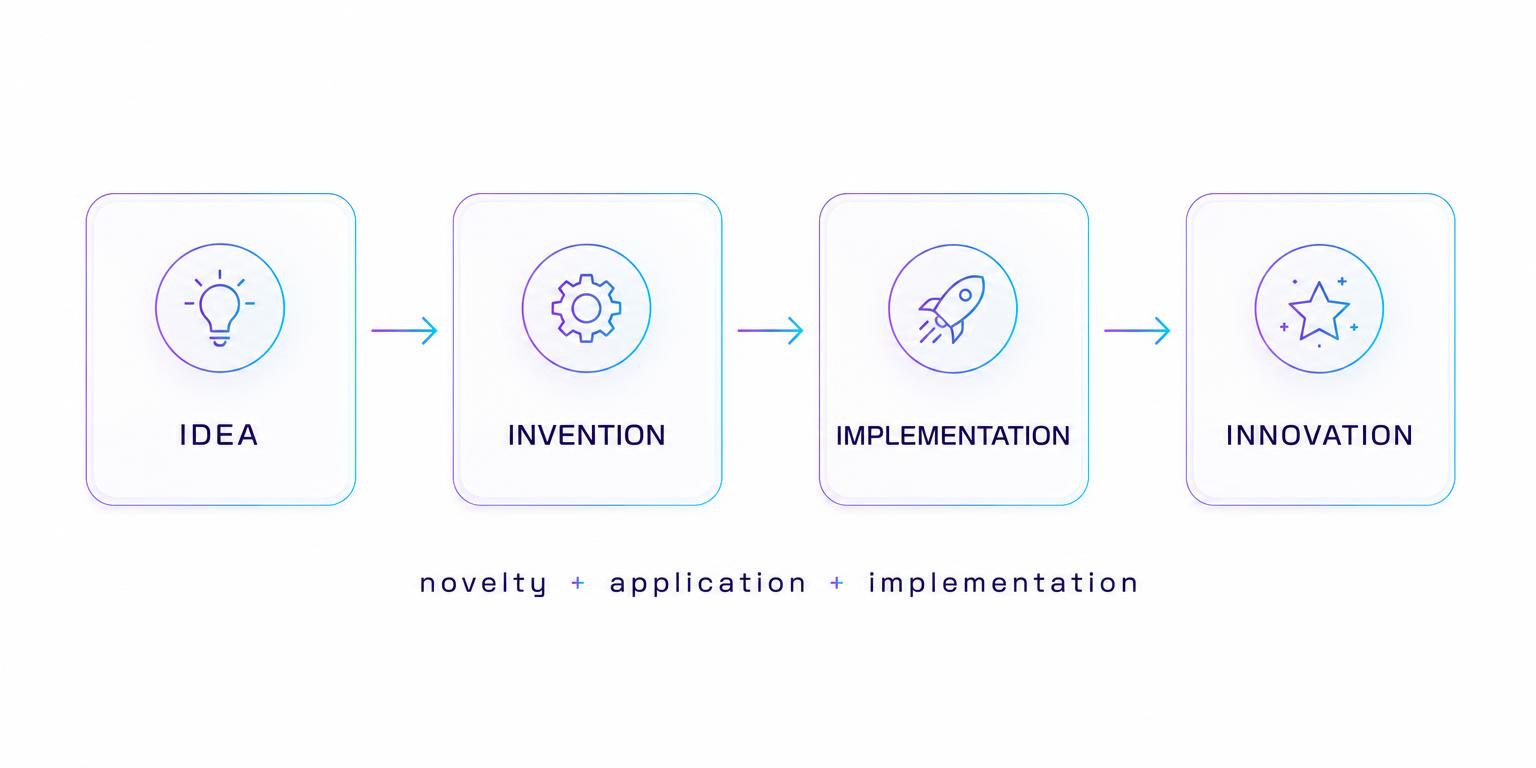
A useful place to begin is with a distinction that is often overlooked: Idea ≠ Invention ≠ Innovation. An idea can exist entirely in someone's mind. An invention can demonstrate that something previously unavailable is technically possible. Innovation requires another step: implementation.
The Organisation for Economic Co-operation and Development (OECD) and Eurostat, in the fourth edition of the Oslo Manual (2018), define innovation around new or improved products and processes that differ significantly from what previously existed for the organisation and have actually been introduced or brought into use. This gives us a useful conceptual sequence: Idea → Invention → Implementation → Innovation.
Innovation therefore exists at the intersection of novelty + application + implementation. And there is another important implication: innovation does not necessarily mean commercial success. An organisation can introduce something genuinely innovative and subsequently discover that users do not adopt it, the economics do not work, regulation prevents scale, or a competitor captures the market instead. Innovation and innovation success are different concepts.
031911–1934 — Joseph Alois Schumpeter: innovation as economic development
Any serious history of modern innovation theory should begin with Joseph Alois Schumpeter. His The Theory of Economic Development first appeared in German in 1911; the English-language edition published by Harvard University Press appeared in 1934. Schumpeter placed entrepreneurship and innovation at the centre of economic development, describing development through what he called new combinations.
His conception was considerably broader than technological invention. Innovation could involve a new good or a new quality of an existing good; a new method of production; the opening of a new market; a new source of supply; or a new form of industrial organisation. This leads to one of the foundational ideas of innovation theory: innovation is not synonymous with technological invention.
In Capitalism, Socialism and Democracy (1942), Schumpeter developed the broader analysis with which the concept of creative destruction became strongly associated. Steam power transformed manufacturing. Electricity transformed factories and cities. Automobiles transformed transportation. Semiconductors transformed electronics. Digital photography transformed photography. The internet transformed communication and commerce. Cloud computing transformed the distribution and economics of software. Artificial intelligence is now transforming many forms of knowledge work. Viewed through the Schumpeterian lens, innovation is not simply the production of interesting new things — it is one of the mechanisms through which economies continuously reconfigure themselves.
041962 — Everett M. Rogers: innovation does not end with creation
A major shift occurred with Everett M. Rogers, whose first edition of Diffusion of Innovations was published in 1962. Rather than concentrating primarily on how innovations are invented, Rogers asked: how do innovations spread through a social system? His work became widely associated with the adopter categories — Innovators → Early Adopters → Early Majority → Late Majority → Laggards. But another part of his work is arguably even more important: he examined five perceived characteristics that affect adoption.
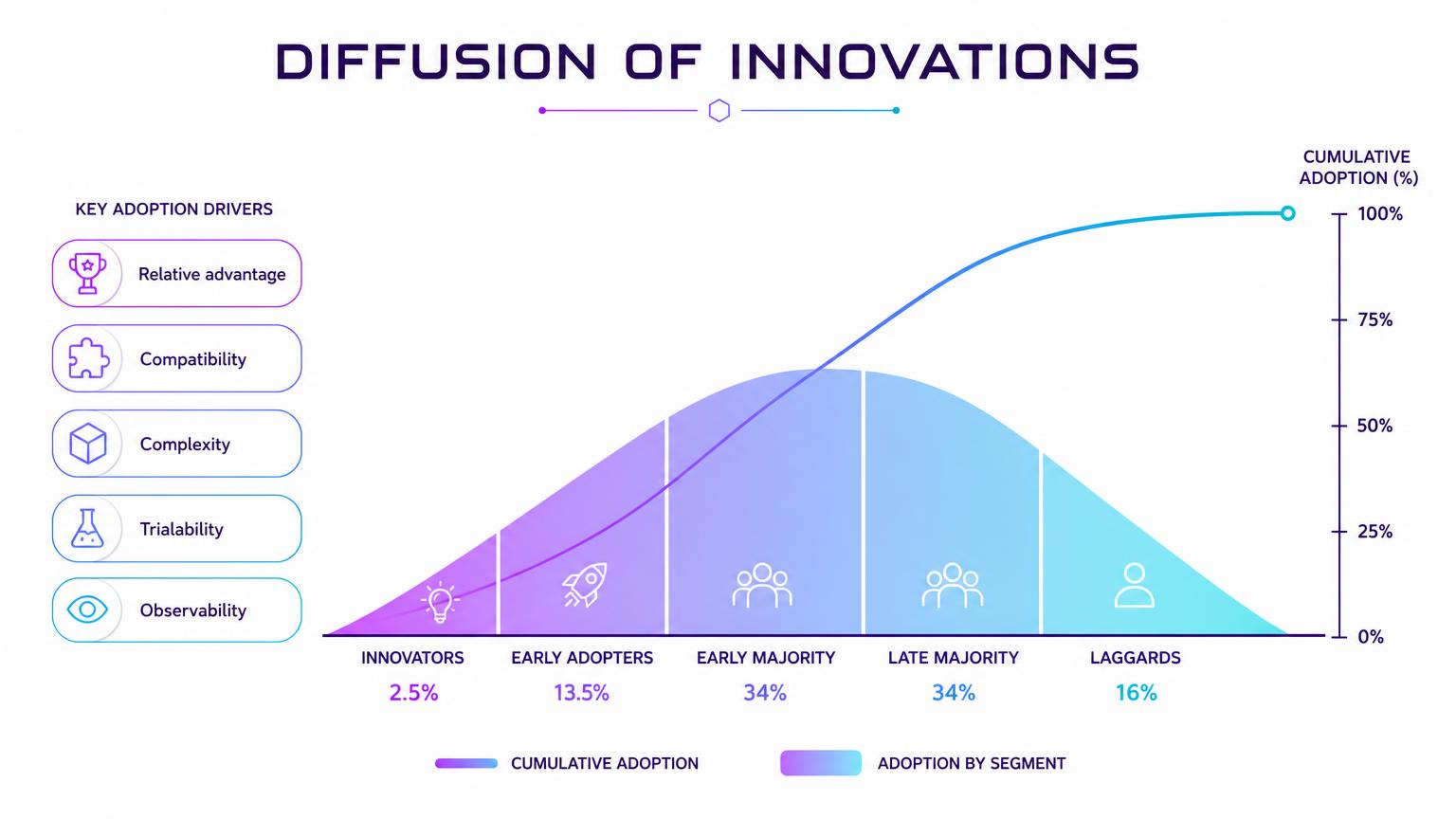
- Relative advantage — is the innovation perceived as better than what it supersedes?
- Compatibility — does it fit the potential adopter's existing values, experiences and needs?
- Complexity — how difficult is it perceived to be to understand and use?
- Trialability — can potential adopters experiment with it before making a full commitment?
- Observability — are its results visible to other people?
05Creation and diffusion are different phenomena
Rogers introduced an enormously important distinction: the characteristics that make something innovative are not necessarily the characteristics that make people adopt it. The technically superior solution does not automatically win. Innovation creation and innovation diffusion are related, but they are different phenomena. Already by 1962, innovation thinking had expanded beyond invention and economic development towards the relationship between an innovation and the people expected to adopt it.
061978 — Abernathy and Utterback: innovation changes as industries mature
In 1978, William J. Abernathy and James M. Utterback published their influential article Patterns of Industrial Innovation. Their work examined how product and process innovation evolve as industries develop. In the early stages of an emerging industry, organisations may experiment extensively with different product concepts: different designs coexist, customer requirements remain uncertain and technological possibilities are still being explored.
Over time, industries may begin to converge around increasingly established product configurations. As this happens, the focus of innovation often shifts towards manufacturing efficiency, reliability, process improvement, scale, quality and cost — broadly from intensive product experimentation towards increasing process innovation and incremental refinement. The nature of innovation depends partly on the maturity of the industry in which it occurs; innovation cannot be fully understood independently of its industrial context.
071985 — Abernathy and Clark: mapping the winds of creative destruction
In 1985, William J. Abernathy and Kim B. Clark published Innovation: Mapping the Winds of Creative Destruction in Research Policy. Their framework examined how innovation affects existing technological and production competencies as well as established market and customer relationships. Instead of asking only “How technologically new is this?”, they encouraged another question: “What does this innovation do to the capabilities and market relationships on which the existing industry depends?”
- Regular innovation — reinforces established production competencies and established market relationships.
- Niche creation — preserves important technical competencies while changing or creating market relationships.
- Revolutionary innovation — disrupts established technical or production competencies while largely retaining existing markets.
- Architectural innovation — disrupts both established competencies and market/customer relationships.
081986 — Tushman and Anderson: competence-enhancing and competence-destroying innovation
In 1986, Michael L. Tushman and Philip Anderson published Technological Discontinuities and Organizational Environments in Administrative Science Quarterly. Their research distinguished between technological discontinuities that are competence-enhancing — building upon capabilities organisations already possess — and competence-destroying — making important existing expertise, knowledge, equipment or organisational routines substantially less valuable.
This explains one of the great paradoxes of innovation: the companies that are strongest under one technological regime are not automatically the strongest under the next one. A new technological generation can transform yesterday's expertise from an advantage into a constraint. Innovation is therefore not simply about learning something new — sometimes it requires organisations to unlearn what previously made them successful.
091986 — David J. Teece: creating innovation and profiting from it are different problems
The same year, David J. Teece published one of the most influential papers on the economics of innovation: Profiting from Technological Innovation. Teece asked a deceptively simple question: why do innovating firms sometimes fail to obtain the economic returns from their own innovations? His analysis highlighted factors including appropriability, the ease of imitation, and complementary assets.
A company may possess an excellent technology but lack manufacturing capacity, distribution, sales capability, service infrastructure, regulatory expertise, customer relationships or other assets needed to bring the innovation successfully to market. Meanwhile, another organisation controlling those complementary assets may capture much of the economic benefit. Creating an innovation and capturing economic returns from that innovation are different problems — a technically superior innovation does not automatically create a commercially superior position.
101988 and 2005 — Eric von Hippel: users can be innovators too
Eric von Hippel, Professor at the Massachusetts Institute of Technology, challenged another traditional assumption: that innovation primarily originates with producers. His book The Sources of Innovation was published in 1988; he further developed his work around user-centred and distributed innovation in Democratizing Innovation (2005).
Von Hippel demonstrated that users themselves can develop important innovations because they encounter needs before producers or the broader market recognise them. His research on lead users is particularly influential: lead users experience needs earlier than the general market and expect significant benefit from finding solutions to those needs. This changes the conventional question — “How can companies innovate for customers?” — into “What if customers and users are themselves part of the innovation process?” The phenomenon is particularly visible in open-source software, scientific instruments, specialist industrial equipment, sports equipment, digital communities and collaborative product development. Innovation, in this view, is no longer exclusively producer-driven; it can be distributed across users and communities.
111990 — Henderson and Clark: innovation can be architectural
In 1990, Rebecca M. Henderson and Kim B. Clark published one of the most influential articles in product innovation theory: Architectural Innovation: The Reconfiguration of Existing Product Technologies and the Failure of Established Firms. Their argument challenged the idea that innovation could be adequately understood simply as incremental or radical. A complex product consists not only of individual components — it also contains an architecture: the relationships through which those components operate together.
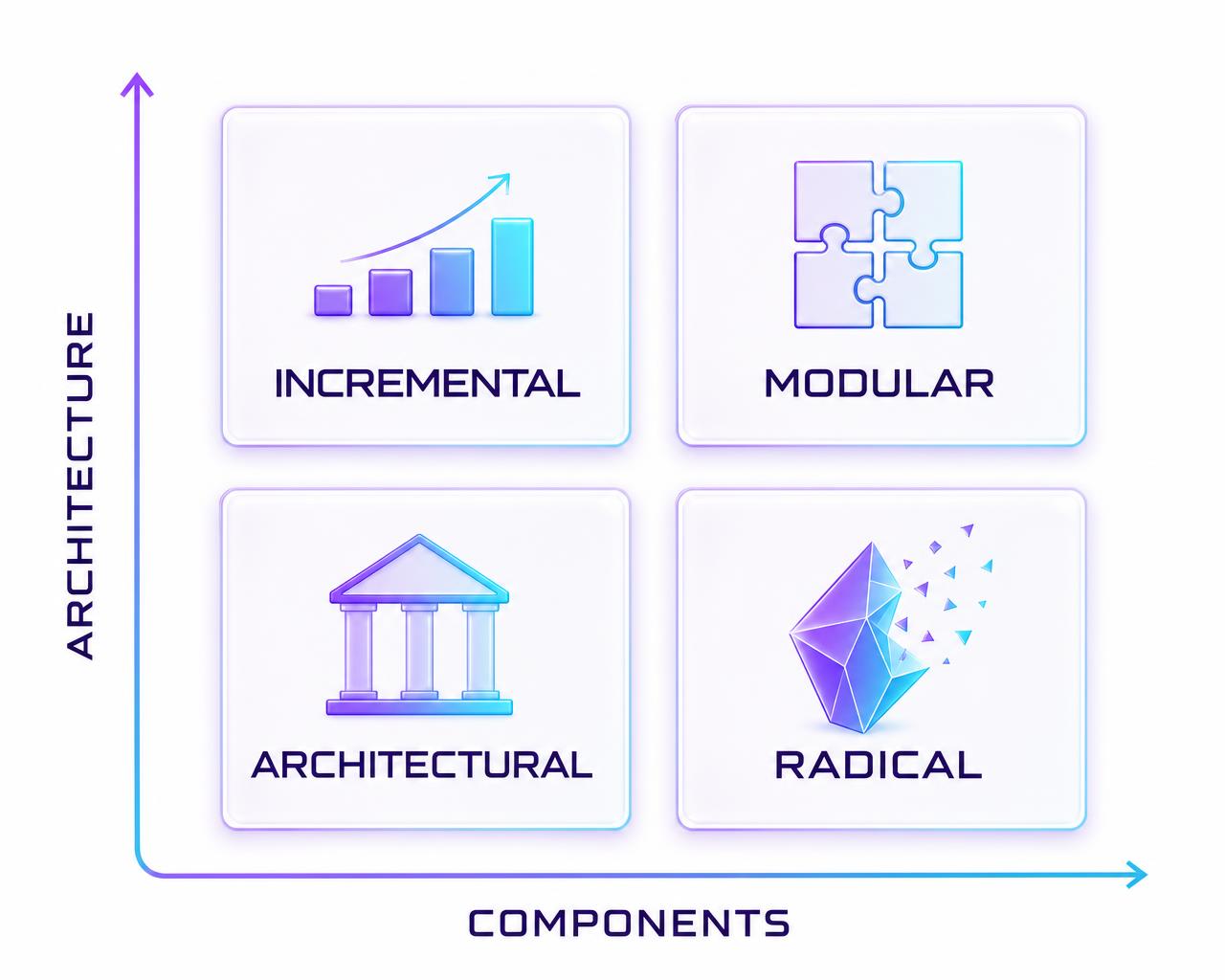
- Incremental innovation — existing core concepts and relationships between components are largely reinforced.
- Modular innovation — a core technological concept embodied in a component changes significantly while the overall architecture remains relatively stable.
- Architectural innovation — the core concepts embodied in individual components remain largely familiar, while the relationships between those components change.
- Radical innovation — both core concepts and the relationships between components change significantly.
12Why architectural innovation matters today
The significance of this framework extends far beyond physical engineering. It explains something increasingly common in contemporary digital innovation: none of the individual technologies necessarily has to be new for the resulting system to be innovative. A modern AI-enabled professional platform might combine a foundation model, existing databases, workflow software, specialist domain knowledge, existing APIs and a user interface. The organisation may have invented none of these technologies individually — yet the architecture connecting them can create something meaningfully new.
131996 and 2004 — Tushman and O'Reilly: the ambidextrous organisation
Innovation creates a difficult problem for established organisations: they need to operate today's business effectively while simultaneously developing tomorrow's business. In 1996, Michael L. Tushman and Charles A. O'Reilly III published Ambidextrous Organizations: Managing Evolutionary and Revolutionary Change, subsequently bringing the concept to a wider management audience through Harvard Business Review in 2004.
Their work examines the organisational tension between exploitation — refining, improving and efficiently operating existing businesses — and exploration — experimenting with new technologies, products, markets, capabilities and business models. Too much exploitation can make an organisation exceptionally efficient at something that is becoming obsolete; too much exploration can create endless experimentation without a sustainable economic core. The challenge becomes: how can a company become better at what works today without becoming incapable of creating what will work tomorrow? Innovation is therefore not fundamentally just a technology problem — it is also an organisational design, capability and leadership problem.
141997 — Clayton M. Christensen: radical does not mean disruptive
Few concepts in modern business language have been used as widely — and as loosely — as disruption. Clayton M. Christensen developed the theory through his research during the 1990s, with The Innovator's Dilemma published in 1997. Within disruptive innovation theory, disruption describes a particular market and competitive trajectory: disruptive entrants characteristically establish themselves through footholds that established organisations have relatively little incentive to defend — particularly low-end or new-market footholds — and can subsequently move towards mainstream customers.
Because the term became so broadly applied, Christensen, Michael E. Raynor and Rory McDonald revisited the theory explicitly in their 2015 Harvard Business Review article What Is Disruptive Innovation? This produces a crucial distinction: radical innovation and disruptive innovation are not synonyms. Radical innovation tells us something about the magnitude or nature of change; disruptive innovation describes a specific competitive trajectory. A technologically radical innovation can be sustaining rather than disruptive, and a disruptive innovation does not necessarily require radically new technology. They describe different dimensions.
15Sustaining innovation: powerful innovation does not have to be disruptive
The theory associated with Christensen also draws attention to sustaining innovation. Sustaining innovations improve products along dimensions already valued by established customers. Importantly, sustaining does not mean incremental — a sustaining innovation can represent a substantial technological breakthrough. A dramatically more powerful medical imaging system designed for existing hospital customers and evaluated according to established performance criteria could represent major technological innovation while reinforcing the existing competitive structure.
This gives us another important principle: an innovation can be technologically extraordinary without being disruptive. The terminology matters because different labels answer different questions.
162003 — Henry Chesbrough: innovation beyond organisational boundaries
In 2003, Henry William Chesbrough published Open Innovation: The New Imperative for Creating and Profiting from Technology. Traditional corporate R&D models often assumed that organisations should generate ideas internally, develop them internally, protect the resulting intellectual property and commercialise the resulting innovations themselves. Chesbrough's concept of Open Innovation challenged this closed-system assumption: useful knowledge can intentionally cross organisational boundaries.
Innovation can involve universities, start-ups, customers, suppliers, research institutions, technology partners, licensing, joint ventures and external intellectual property. A pharmaceutical innovation, for example, might involve scientific discoveries originating at a university, biotechnology developed by a start-up, clinical research conducted through hospitals, data infrastructure supplied by a technology company and eventual commercialisation through a larger pharmaceutical organisation. So where is “the innovation”? Increasingly, the answer may not be inside one organisation at all — it may exist across a network of organisations. This perspective has become particularly relevant in artificial intelligence, biotechnology, pharmaceuticals, climate technology and other fields where critical knowledge is distributed across multiple actors.
172013 — Keeley, Walters, Pikkel and Quinn: innovation across the whole business
In 2013, Larry Keeley, Helen Walters, Ryan Pikkel and Brian Quinn published Ten Types of Innovation: The Discipline of Building Breakthroughs. The practical importance of the framework lies in rejecting another widespread assumption: innovation is not confined to product development. The ten types are grouped around three broad areas.
- Configuration — how the organisation operates: Profit Model, Network, Structure, Process.
- Offering — what the organisation provides: Product Performance, Product System.
- Experience — how customers interact with the organisation and offering: Service, Channel, Brand, Customer Engagement.
18Product innovation is only one possible location
The important idea is not merely that there are ten categories — it is the change in perspective. Consider a smartphone ecosystem. Innovation may exist in the physical device, but it can simultaneously occur in the operating system, the developer ecosystem, payments, subscriptions, distribution, services, integration between devices and customer experience. Many powerful modern innovations therefore consist of multiple types of innovation working together.
192018 — OECD and Eurostat: a contemporary institutional definition
The fourth edition of the OECD and Eurostat Oslo Manual, published in 2018, represents an important contemporary reference point for defining and measuring innovation internationally. The 2018 edition reorganised the main business-level classification around two broad types: product innovation — a new or improved good or service that differs significantly from the firm's previous goods or services and has been introduced to the market — and business process innovation — a new or improved business process affecting one or more business functions, differing significantly from previous processes and actually brought into use.
This is significant because innovation does not need to appear as a physical invention, a patent, a scientific discovery or a new product sold directly to customers. Innovation can occur in production, information systems, logistics, administration, product development, marketing, sales and other organisational functions. Modern innovation therefore extends far beyond traditional R&D departments.
20Innovation is relative: new to the world is not the only kind
The OECD framework also helps correct another common misconception: something does not necessarily have to be entirely new to humanity to represent innovation. Innovation has a reference point. A process can represent significant innovation for one organisation even if another organisation has used something similar before. This gives us several useful levels of novelty.
- New to the organisation
- New to the market
- New to the industry
- New to the world
21Meaningful adoption in a new context
Imagine a traditional manufacturer introducing AI-enabled predictive maintenance for the first time. The company has not invented artificial intelligence. It has not invented predictive maintenance. But the implementation may still represent a significant change relative to its previous operations. This distinction is particularly important in discussions about digital transformation and AI transformation: sometimes innovation lies in meaningful adoption and implementation in a new context — not in “nobody in the world has ever done this before”.
22One innovation can belong to several categories simultaneously
After more than a century of innovation research, perhaps one of the most important conclusions is that we should stop looking for one universal list of innovation types. The major theories answer different questions, and these classifications are not mutually exclusive — they operate on different analytical dimensions.
| Period | Lens | Core question | Thinkers / frameworks |
|---|---|---|---|
| 1911 onward | Economic development | What new combinations change economic activity? | Joseph Alois Schumpeter |
| 1962 onward | Diffusion | Why and how does innovation spread? | Everett M. Rogers |
| 1978 onward | Industry evolution | How does innovation change as industries mature? | William J. Abernathy & James M. Utterback |
| 1985 | Competitive impact | What capabilities and market relationships are preserved or destroyed? | William J. Abernathy & Kim B. Clark |
| 1986 | Organisational competence | Does technological change enhance or destroy existing expertise? | Michael L. Tushman & Philip Anderson |
| 1986 | Commercialisation | Who profits from technological innovation and why? | David J. Teece |
| 1988 onward | Source of innovation | Can users themselves be innovators? | Eric von Hippel |
| 1990 | Product architecture | Do components change, relationships change, or both? | Rebecca M. Henderson & Kim B. Clark |
| 1996 onward | Organisational capability | How can organisations explore and exploit simultaneously? | Michael L. Tushman & Charles A. O'Reilly III |
| 1997 onward | Market disruption | How can entrants challenge incumbents? | Clayton M. Christensen |
| 2003 onward | Knowledge flows | Can innovation cross organisational boundaries? | Henry William Chesbrough |
| 2013 | Business-system innovation | Where across the business can innovation occur? | Larry Keeley, Helen Walters, Ryan Pikkel & Brian Quinn |
| 2018 | Definition & measurement | What counts as implemented innovation? | OECD & Eurostat |
23Applying several theories to the same innovation
Consider a hypothetical AI-enabled diagnostic platform. According to the Oslo Manual, it might represent product innovation if it introduces a significantly different service. According to Henderson and Clark, it might represent architectural innovation if established technologies are connected in fundamentally new ways. According to Chesbrough, its development might involve Open Innovation if hospitals, universities, AI companies and biotechnology partners contribute knowledge.
According to Christensen, it might be sustaining rather than disruptive if it initially provides better diagnostic capabilities to established healthcare institutions. According to Teece, commercial success might depend less on the algorithm itself than on complementary assets such as clinical validation, regulatory capability, hospital integration and distribution. According to Rogers, adoption might remain slow despite impressive technology because the system is difficult to trial, complex to integrate or incompatible with established clinical workflows. All of these descriptions could simultaneously be correct — they are simply looking at different properties of the same innovation.
24How the meaning of innovation has expanded
Looking at the theories chronologically reveals something particularly interesting: the intellectual history of innovation has progressively expanded the unit of analysis. The concept has moved from something resembling “a new combination introduced by an entrepreneur” towards something much broader: “a meaningful new configuration of technologies, capabilities, relationships, processes and behaviours that is actually put into use.”
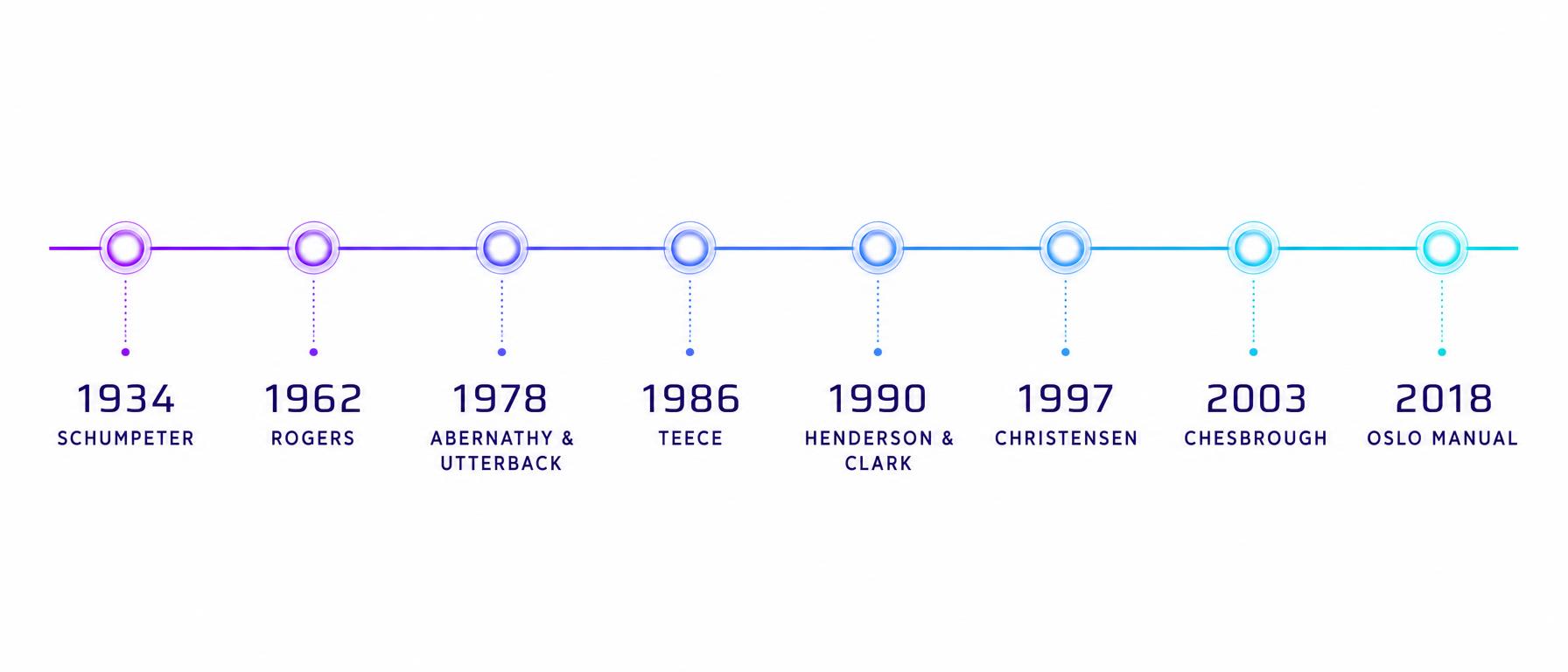
- Early twentieth century — innovation understood in relation to entrepreneurship and economic development.
- Mid-twentieth century — adoption and diffusion through society.
- 1970s–1980s — industry evolution, technological change, organisational capabilities and commercialisation.
- 1990s — product architecture, organisational adaptation and competitive disruption.
- 2000s — open organisational boundaries, distributed knowledge and user innovation.
- 2010s and beyond — products, services, processes, business models, digital systems, organisational transformation and ecosystems.
25Innovation in the 21st century: from invention to recombination
The traditional image of innovation often appears linear: Scientific discovery → Invention → Product → Market. Contemporary innovation increasingly looks different — it is often distributed, iterative, interconnected and systemic. Artificial intelligence provides an excellent example: a company does not necessarily need to develop a new foundation model to innovate with AI. It might combine an existing AI model, proprietary organisational data, specialist professional knowledge, existing software infrastructure, new workflows, automation and a new user experience. None of those individual components necessarily needs to be new — yet their combination, architecture and application can produce something significantly different.
The same phenomenon appears across biotechnology, digital health, fintech, climate technology, advanced manufacturing, robotics, education technology and professional services. This suggests an important evolution in our understanding: innovation increasingly comes from recombination as much as invention.
26Innovation is becoming more systemic
Innovation increasingly takes place not within isolated products or organisations but across systems and ecosystems. Consider the electric vehicle: the innovation cannot be fully understood by looking only at the car. It involves battery chemistry, battery-management systems, software, charging infrastructure, electricity networks, manufacturing, navigation, payments, regulation, financing and new service models. Similarly, modern biotechnology innovation can connect academic science, artificial intelligence, laboratories, clinical medicine, regulation, manufacturing, investment, data and healthcare systems.
The unit of innovation therefore becomes increasingly difficult to isolate. Sometimes the innovation is a product. Sometimes it is a process. Sometimes it is an architecture. Sometimes it is a business model. Sometimes it is an organisational capability. And sometimes the meaningful innovation is the system connecting all of them.
27Artificial intelligence makes the definition more important, not less
Using AI does not automatically make an organisation innovative. Adding a chatbot to an existing website may represent adoption of a new technology without significantly changing the product, process, organisation or competitive model. By contrast, redesigning an entire professional workflow around AI may represent substantial process innovation even when the underlying AI model was developed by another company. An AI-native product might involve architectural innovation; a new AI-enabled service might constitute product innovation; AI implementation inside an established organisation might create business-process innovation.
An AI-enabled model that makes previously expensive expertise accessible to entirely new users could potentially create the conditions for market disruption — but whether it is genuinely disruptive in the sense developed by Christensen would depend upon its competitive trajectory, not simply the presence of AI. As “AI-powered” becomes commonplace, this distinction becomes increasingly important: the presence of advanced technology tells us surprisingly little by itself about the nature of the innovation.
28Technology and innovation are not the same thing
Perhaps one of the most important misconceptions to remove is: Technology ≠ Innovation. Technology can enable innovation. Scientific discovery can enable innovation. An invention can enable innovation. Data can enable innovation. Artificial intelligence can enable innovation. But innovation emerges when novelty is meaningfully implemented in products, services, processes, architectures, organisations, markets or combinations of them.
A business can possess extraordinary technology and innovate very little around it. Another organisation can use widely available technology and create a highly innovative system. This is why asking “What technology are you using?” is fundamentally different from asking “What exactly is innovative here?”
29A contemporary definition of innovation
Bringing together more than a century of innovation thinking — from Schumpeter through Rogers, Abernathy, Utterback, Clark, Tushman, Anderson, Teece, von Hippel, Henderson, Christensen, O'Reilly, Chesbrough, Keeley and colleagues, together with the contemporary OECD and Eurostat framework — produces a richer understanding. A useful contemporary working definition might be: innovation is the implementation of a meaningfully new or significantly improved way of creating, delivering or enabling outcomes through products, services, processes, technologies, organisational systems, business models or combinations of them.
- Novelty — something is meaningfully different from the relevant reference point.
- Implementation — innovation exists beyond the idea.
- Application — knowledge, technologies or new combinations are put into practical use.
- Change — something meaningful changes: a product, process, capability, experience, behaviour, organisation or market.
- Context — how innovative something is depends partly on what it is being compared with.
- System — increasingly, innovation can reside not in one isolated component but in the relationships between technologies, organisations, capabilities and users.
30The most useful question is no longer “Is it innovative?”
More than a century of innovation theory tells us something surprisingly simple: innovation is not one thing. It can be incremental without being trivial. It can be radical without being disruptive. It can be disruptive without relying on revolutionary technology. It can change a component without changing an architecture. It can change an architecture without inventing the components. It can reinforce existing organisational competencies or destroy them. It can originate with producers, users, universities, start-ups or networks of organisations. It can occur within a product, a process, a business model, an organisation or an entire ecosystem.
And creating it is only the beginning. It still needs to be implemented. It may require complementary assets to reach the market. It must diffuse. People and organisations must decide whether to adopt it. And the organisation that creates it is not necessarily the organisation that ultimately benefits most from it.
So perhaps the most useful question for innovation in the twenty-first century is no longer “Is this innovative?” Instead, we should ask: What exactly is innovative about it? For whom is it new? How significant is the change? Is the innovation in the technology, the product, the architecture, the process, the business model — or their combination? Which existing capabilities does it strengthen, and which does it make obsolete? Does it improve an existing market or create a different competitive trajectory? Where did the knowledge required to create it come from? What complementary capabilities are needed to make it viable? And will people and organisations actually adopt it? Those questions tell us considerably more about innovation than the label “innovative” ever could.
References
- [1]https://doi.org/10.1787/9789264304604-en
- [2]https://books.google.com/books/about/Diffusion_of_Innovations.html?id=lw4-AAAAIAAJ
- [3]https://www.jstor.org/stable/2392832
- [4]https://doi.org/10.1016/0048-7333(86)90027-2
- [5]https://evhippel.mit.edu/books/
- [6]https://www.jstor.org/stable/2393549
- [7]https://www.christenseninstitute.org/book/the-innovators-dilemma/
- [8]https://hbr.org/2015/12/what-is-disruptive-innovation
- [9]https://books.google.com/books/about/Open_Innovation.html?id=4hTRWStFhVgC
- [10]https://direct.mit.edu/books/book/2821/Democratizing-Innovation
- [11]https://www.wiley.com/en-us/Ten+Types+of+Innovation%3A+The+Discipline+of+Building+Breakthroughs-p-9781118571392