
Guide
User Onboarding: a practical guide to first-run success
A field guide to designing onboarding that gets new users to value in minutes, not days — with the framework, patterns, and metrics we use across SaaS and B2B products.
What is user onboarding?
User onboarding is the structured experience that guides a new user from sign-up to their first meaningful outcome. It is not a product tour — it is the shortest credible path from intent to value.
Onboarding vs. activation vs. adoption
Onboarding is the experience. Activation is the moment a user reaches first value. Adoption is the sustained behavior that follows. Good onboarding compresses time-to-activation; adoption then compounds it.
Why first-run experience decides retention
Most churn is decided in the first session. If a user does not reach an aha moment quickly, they rarely come back. Onboarding is therefore the highest-leverage surface in the entire product.
A framework for designing user onboarding
Treat onboarding as a funnel with a clearly defined activation event at the end.
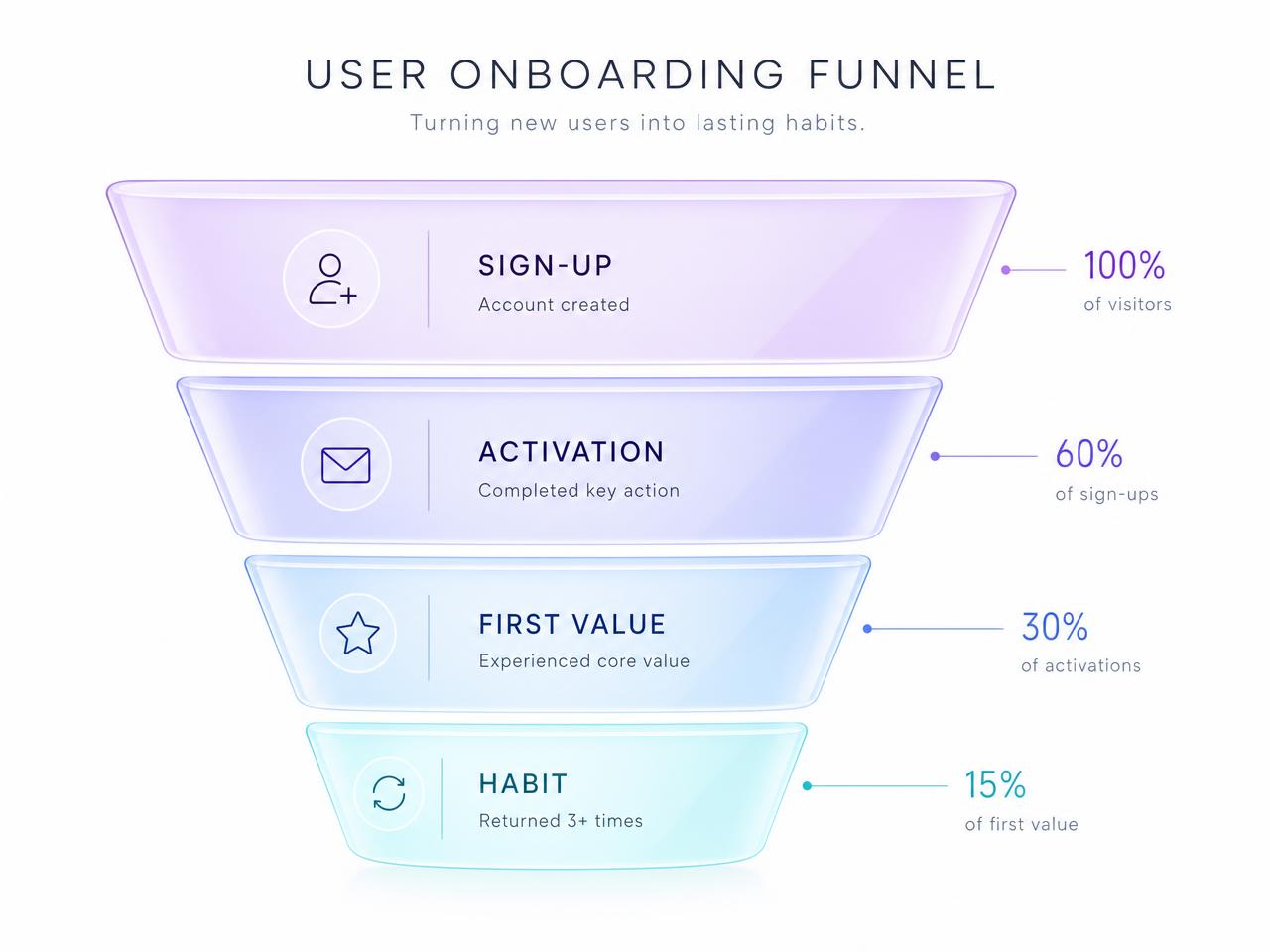
1. Define the activation event
Pick one observable behavior that correlates with retention (e.g. first project created, first message sent, first integration connected).
2. Map the shortest path
List every step between sign-up and that event. Remove anything that does not unblock the next step.
3. Personalize the entry point
Use a one-screen role or goal question to route users into the workflow most relevant to them.
4. Teach in context
Replace upfront tours with tooltips, empty states, and checklists that appear at the moment of need.
5. Measure and iterate
Track conversion at each step weekly. The biggest drop-off is always the next experiment.
User onboarding patterns that work
Progress checklists
Visible checklists with 3–5 setup tasks dramatically increase activation by making progress legible and finite.
Empty states with sample data
Pre-populated examples let users explore the product before they have their own data, lowering the cognitive cost of starting.
Just-in-time tooltips
Show guidance the first time a user encounters a feature, not in a dismissable tour at sign-up.
Lifecycle email and in-app nudges
Behavior-triggered messages re-engage users who stalled before activation, ideally within 24 hours.
Metrics to track
Time to first value (TTFV)
Median minutes from sign-up to activation event. Cut this in half and retention almost always improves.
Activation rate
Percent of new sign-ups who hit the activation event within a defined window (often 7 days).
Step-level conversion
Funnel conversion between each onboarding step. The largest drop is your next priority.
Week-1 retention
Percent of activated users still active 7 days later. This is the ultimate scoreboard for onboarding quality.
Frequently asked questions
+How long should user onboarding take?
Aim for under 5 minutes to first value for self-serve products and a single guided session for B2B. Length is not the metric — time-to-value is.
+Should onboarding be a product tour?
No. Tours have low completion and weak retention impact. Teach in context, when the user is about to use a feature.
+What is a good activation rate?
Benchmarks vary, but a healthy self-serve SaaS typically sees 25–40% of sign-ups activate within 7 days. Compare yourself to your own trend, not to averages.
+How is user onboarding different from customer onboarding?
User onboarding is the in-product experience for any new user. Customer onboarding is the broader post-sale program for a paying account — often touched by CS, training, and integrations.
+When should I rebuild onboarding?
When activation has plateaued for two or more quarters, when the ideal customer profile shifts, or when a major new use case has been added.